
EverSettled News
August 6, 2026
Empathetic Agents Hackathon: We Asked AI to Show Up for People at Their Worst
We brought 50 builders, 10 senior judges, and partners ElevenLabs and Lovable to Entrepreneur First's London office to answer the question the AI industry keeps skipping: not how to make an agent talk, but how to make one that knows when to stop. Both winning teams, out of 10+ submissions, independently built the same thing: the layer that decides not to act.
By EverSettled
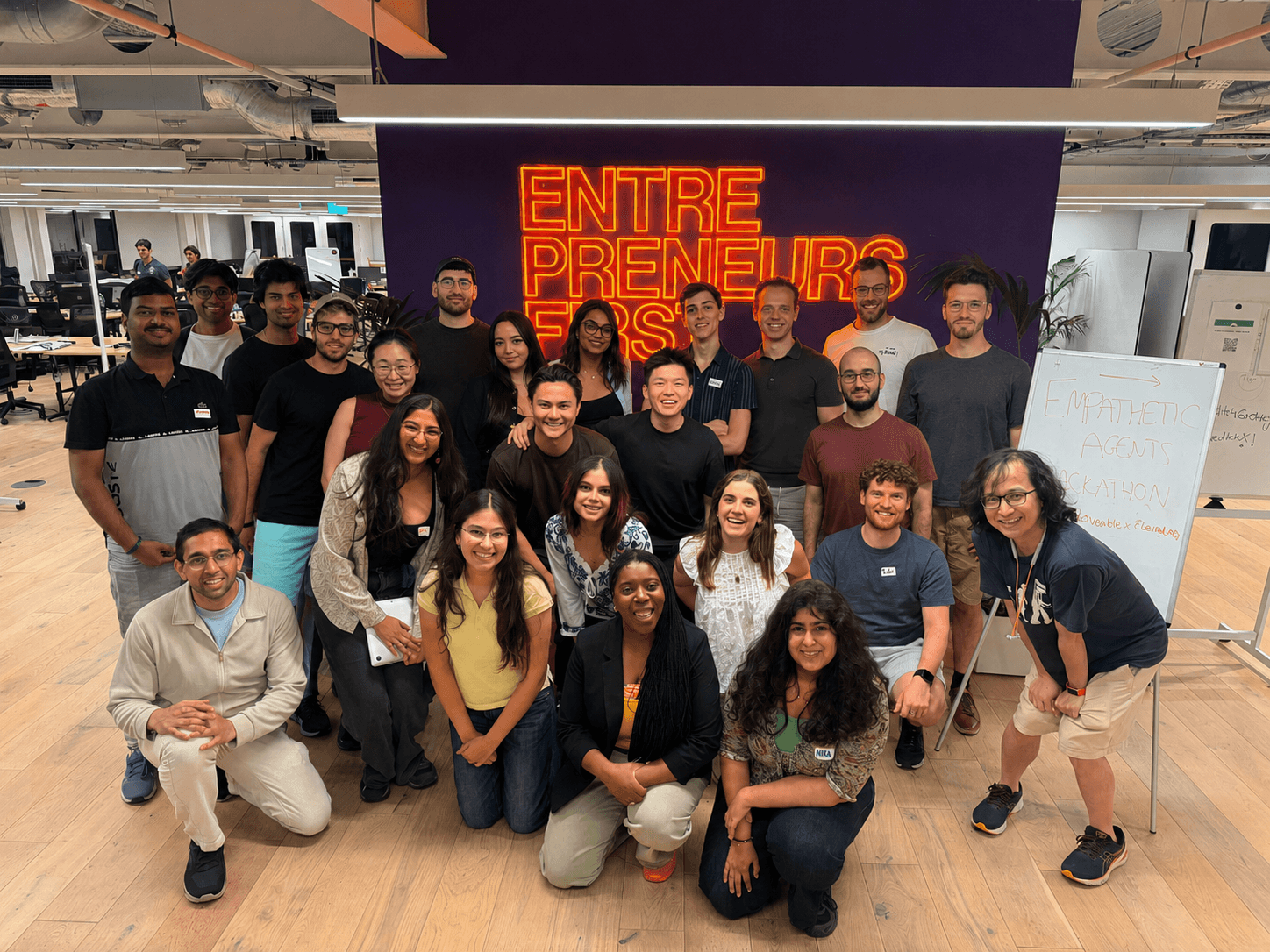
Empathetic Agents: What 50 Builders Made When We Asked AI to Show Up for People at Their Worst
There is a question the AI industry keeps not asking.
We have spent three years teaching models to answer. To be fluent, helpful, tireless, endlessly available. What almost nobody has worked on is the opposite skill: knowing when to say less. Knowing when a cheerful, confident, technically correct answer is exactly the wrong thing to give someone.
That question matters more to us than most. At EverSettled, we help families settle the affairs of someone who has died. Our users do not arrive with a task. They arrive in the middle of the worst months of their lives, and they are handed paperwork. If AI is going to be useful to people like that, fluency is not the hard part. Restraint is.
So on 30 July, we put the question in a room and see what happened.
The setup
Fifty builders. Entrepreneur First's London office. Four hours. Partners ElevenLabs and Lovable backing the teams with voice infrastructure and build credits, and a hosted model gateway so nobody lost an hour of a four-hour night to API setup.
We split the brief into two tracks, deliberately pulling in opposite directions.
Track 1, Presence. Build an agent that helps someone through something hard, not by answering one question well, but by being there for the stretch of it. What does it remember? How does it decide when to check in and when to leave someone alone?
Track 2, Guardrails. Build the layer that catches an empathetic agent when it gets something wrong. The checks that stop it overstepping around death, grief, legal or financial matters. The detector that spots when a message is a real crisis and not ordinary frustration.
And then we assembled a judging panel with no patience for a nice demo. Maria Luque Anguita, Talent Investor at Entrepreneur First. Tom Love, CEO, and Adrian Sager, CTO, both of Latent Engineering. Jaka Bavdek, CEO at 8x, with Darijan Ducic, Founder's Associate. Preesha Gehlot, CTO at Iridium. Victor Humenhuk, AI Risk Intelligence at LSEG. And from EverSettled, Jacob Effenberger, Anis Belmokhtar and Tobias Budig. Ten judges, scoring every team on originality, technical execution, applicability, and whether the thing in front of them actually did what the brief asked.
More than 10 projects were submitted before the deadline. The quality of the top end was, frankly, not what you expect from a single evening.
Track 2 winner: Emile
The team of Sophia Hussain, Tanya Sengupta and Chunteng Xiao built the guardrail we have wanted to exist for a long time, and they built it on an insight most crisis-detection systems get wrong.
Almost every safety classifier in production scores a message in isolation. Is this text distressed? Does it contain risk language? Emile does something smarter. It sits underneath an empathetic agent and watches how a person is talking, comparing every turn against how that same person sounded ten minutes earlier. Then it picks one of four responses: carry on, slow down, check in, or step back completely.
The team put it best themselves: they score the change, not the state. Someone who has been quiet the entire conversation is sad. Someone who was fine and has stopped being fine is the one worth catching, and you can only see that by looking across turns.
Underneath sit two behavioural science frameworks, written as readable rules rather than a trained black box, so you can inspect exactly why the system fired. One tracks where a person is in relation to the thing they are facing: avoiding it, circling it, getting ready, getting on with it. The other checks whether they have the bandwidth, timing and engagement to keep going right now. Feeding those are a small set of chosen signals, including answers getting shorter, steering away from the subject, absolutes creeping in, and speaking about someone who has died in the present tense.
Crucially, nothing escalates on a single word. It takes several signals moving together. That is why Emile catches the calm, well-organised message that is actually a crisis, and correctly ignores the person loudly complaining that the paperwork is killing them.
Even the name was well chosen. Émile Durkheim studied what happens to people when the rules of their life stop applying, and found the danger is not the grief itself but the gap after the old structure goes and before a new one arrives. That gap is what the team built for. Their own stated next step, tuning thresholds against real transcripts rather than scripts they wrote themselves, is exactly the right instinct, and it is the kind of intellectual honesty that separates a serious system from a demo.
Built with React, OpenAI and ElevenLabs.
Track 1 winner: Still Here
Alex Choi and Noah Pham started from an observation anyone who has lost someone will recognise. Grief support arrives all at once, then fades, while the difficult moments keep coming for years.
Still Here is a memory companion that knows when to call. It connects approved memories to upcoming moments in a person's calendar, a job interview, an anniversary, a family tradition, and reaches out with a gentle voice conversation at the point where it will actually land.
What earned it the track was not the voice quality. It was the restraint engineered around it. The team built an agent that independently decides whether, when and why to reach out, and is fully capable of deciding not to. Every call is grounded in memories the user has explicitly approved, safety-checked twice, and accompanied by an inspectable trace explaining the agent's reasoning. They built explicit safeguards around consent, quiet hours, contact frequency, sensitive topics, impersonation and dependency language.
The architecture is genuinely ambitious for four hours: Next.js, React and TypeScript on the front, a LangGraph service evaluating upcoming events, selecting relevant memories, applying safety checks and preparing each outreach, with ElevenLabs and Twilio powering real-time phone calls and SQLite holding profiles, memories, events and call history.
Their own takeaway is the line we would put on the wall: empathetic AI depends less on sounding human and more on respecting boundaries. Clear identity, consent, restraint, transparency, and the ability to decline. And their stated goal for what comes next tells you they understand the terrain they are on. They want Still Here to support people without ever trying to replace the person they lost.
What the night proved
Two teams, two opposite briefs, one shared conclusion. Both winners spent their four hours building the part of the system that decides not to act.
That is a striking result. Given free rein and a room full of frontier models, the strongest builders in that room did not chase a more eloquent agent. They built the judgment layer. Emile decides when an agent should stop helping. Still Here decides whether it should start. Both treat silence as a feature that has to be engineered, not an absence of one.
We think that is where the real work in applied AI is heading, and it is why we ran this event. The models are already good enough to talk to someone in the worst week of their life. What is missing is the infrastructure that decides whether they should.
Enormous thanks to ElevenLabs and Lovable for backing the night, to Entrepreneur First for hosting us, to our 10 judges for giving up an evening and holding a genuinely high bar, and to all 50 builders who chose to spend a Thursday on one of the least glamorous and most quietly important problems in the field.
Congratulations to Sophia, Tanya and Chunteng, and to Alex and Noah. We cannot wait to see where you take these.
This is the first Empathetic Agents. It will not be the last.
Empathetic Agents, London, 30 July 2026. Hosted by EverSettled in partnership with ElevenLabs and Lovable, at Entrepreneur First.